
Two strips of LED tape can carry the same wattage, the same color temperature and the same price, and still look completely different once they are installed. The difference lives in details most people never see: the chip, the phosphor, the way LEDs are sorted, and how the whole system handles heat and power. This page walks through those details in plain language, with charts, so you know exactly what to look for and why it matters.
How a white LED makes light
Every white LED starts as a tiny blue light. The chip itself emits a narrow band of blue, and a coating of phosphor sitting on top of it absorbs part of that blue and glows across the rest of the spectrum. Blue light that passes through, plus the phosphor's broad glow, mixes into what our eyes read as white.
That phosphor recipe is where quality is won or lost. A basic blend produces plenty of lumens but leaves a gap in the deep reds. A richer blend fills that gap, so the light carries more of the colors found in daylight and in warm incandescent light. You cannot see the recipe on the reel, but you can see its result on every surface the light touches.
Color rendering (CRI): seeing true color
The Color Rendering Index, or CRI, measures how faithfully a light source shows colors compared with a reference light of the same color temperature. The scale tops out at 100. Under a high-CRI source, a lemon looks like a lemon: bright, juicy yellow with a clean green-yellow at the stem. Under a low-CRI source, the same fruit turns flat and slightly greenish, and the strawberries beside it lose their red.
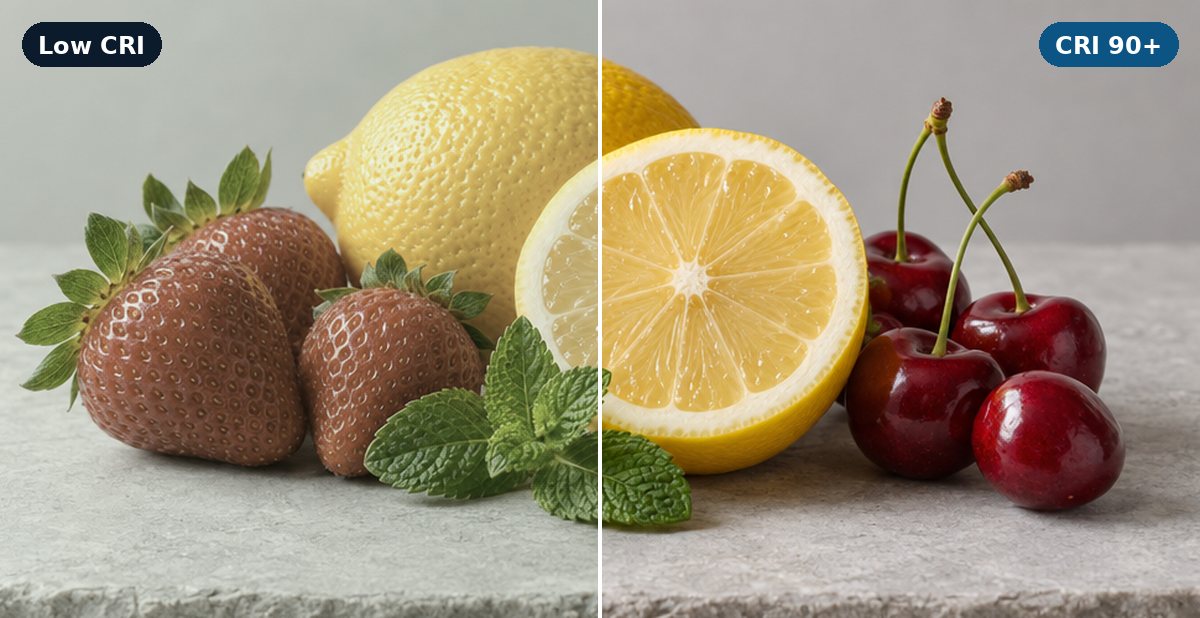
What the number actually measures
To calculate CRI, a light is shone on a set of standard test colors, each scored from 0 to 100 on how close it comes to the reference. The familiar CRI number, written Ra, is simply the average of the first eight scores, R1 to R8. Those eight are all soft, pastel tones. That is why two sources with the same Ra can still look different: Ra does not include the saturated colors.
Why R9 matters
R9 is the score for a strong, saturated red, and it is the one most often left off a spec sheet. Red shows up everywhere people care about how a space looks: skin tones, wood, leather, brick, food, fabric and artwork. A typical 80 CRI LED can score close to zero on R9, while a well-made 90+ CRI LED usually scores well above 50. If you compare two products, ask for R9 alongside CRI.
Beyond CRI: TM-30
A newer method, IES TM-30, scores light against 99 color samples instead of eight. It reports two main numbers: Rf, for overall fidelity (how accurate colors are), and Rg, for gamut (whether colors look more or less saturated than the reference). Together they give a fuller picture than CRI alone, and they are becoming more common on quality spec sheets.
Seeing the scale
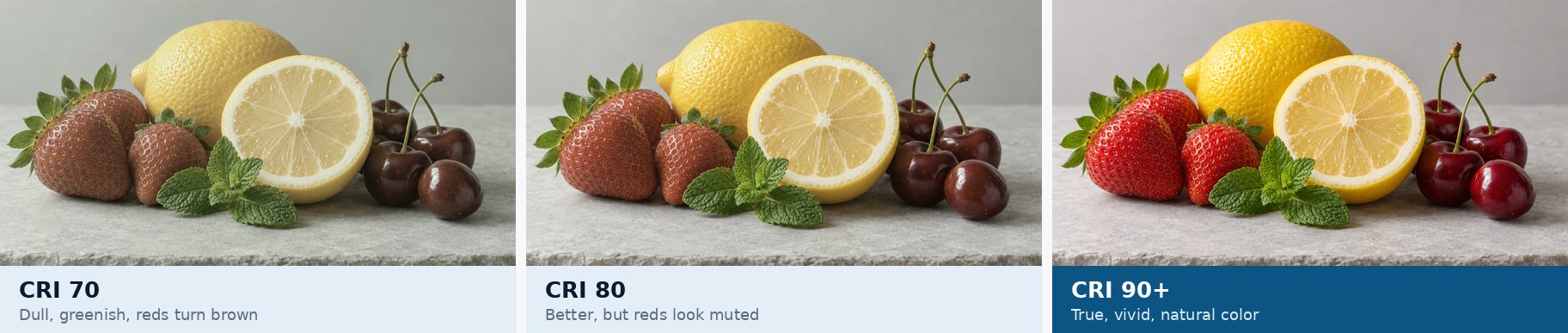
| CRI (Ra) | What it looks like | Where it fits |
|---|---|---|
| Below 80 | Flat, slightly washed-out color | Utility spaces where color does not matter |
| 80–89 | Acceptable, but reds and skin tones look muted | Back-of-house, storage, basic general lighting |
| 90–94 | Natural, rich color that people notice and like | Homes, offices, hospitality, retail |
| 95+ | Very close to the reference light | Galleries, high-end retail, color-critical work |
Color temperature (CCT): the mood of the light
Correlated color temperature describes whether white light looks warm or cool, measured in kelvin (K). Lower numbers are warm and golden, like candlelight or an old incandescent bulb. Higher numbers are crisp and bluish, like daylight on an overcast afternoon. CCT says nothing about color accuracy; that is CRI's job. It sets the mood.
| CCT | Feel | Common uses |
|---|---|---|
| 2700K | Warm, cozy, like incandescent | Living rooms, bedrooms, restaurants, hospitality |
| 3000K | Warm but clean, like halogen | Kitchens, lobbies, retail, most residential work |
| 3500K | Balanced neutral white | Offices, mixed-use spaces, bathrooms |
| 4000K | Crisp, cool and alert | Workspaces, garages, task and display lighting |
| Tunable / dim-to-warm | Changes through the day | Spaces used from morning to night |
One tip: keep one CCT within a single sightline. Mixing 3000K tape with 4000K downlights in the same room makes both look wrong.
Color consistency: binning and MacAdam ellipses
No two LED chips come off a production line exactly alike. Tiny differences in the chip and the phosphor shift each LED's color slightly. Manufacturers measure every LED and sort them into groups, called bins, by color, brightness and voltage. The tighter the bins a tape is built from, the more alike every foot of it looks.
Color consistency is measured in MacAdam ellipses, also called SDCM steps. Each ellipse marks a zone on the color chart where LEDs look alike to the human eye. A 1-step zone is so tight that differences are invisible. By about 5 steps, two segments side by side on the same wall start to look different. The standard color temperature bins are roughly 7 steps wide, which is why "3000K" alone does not guarantee a match.
Consistency matters more for linear light than almost anywhere else. A downlight is a single point; a line of tape runs along a wall or ceiling, joint after joint, lighting the same surface. Any mismatch becomes a visible seam. For long continuous runs, look for 3-step consistency or tighter, order the whole job at once, and keep a little extra tape from the same batch for future repairs.
Lifetime and heat: what L70 means
LEDs rarely burn out the way a bulb does. They fade, slowly, over tens of thousands of hours. So the useful question is not "when will it fail?" but "how long until it is noticeably dimmer?" The industry answer is L70: the number of hours until the light drops to 70 percent of its original output, the point where most people begin to notice.
Lifetime figures come from testing. Under the LM-80 standard, LEDs are run for thousands of hours at controlled temperatures while their output is measured. The TM-21 method then projects that data forward, and it limits how far the projection can go based on how long the test actually ran. A claim with no test data behind it is just a guess.
Heat is the enemy of every LED. The same tape that lasts for decades when it is mounted in an aluminum channel can fade far sooner stuck to wood or drywall in a closed cavity. Aluminum draws the heat away, protects the tape and keeps its color and output stable. It is one more reason we design tape, channel and driver as one system.
Efficacy: light for every watt
Efficacy measures how much light a source produces for the power it uses, in lumens per watt (lm/W). Higher is better: more light, less energy, less heat. Quality LED tape is several times more efficient than the incandescent and halogen sources it replaces.
There is a trade-off worth knowing: high-CRI phosphors put more energy into deep reds, where the eye is less sensitive, so a 90+ CRI tape gives up a few lumens per watt compared with an 80 CRI tape. We think the color is worth it. Light that makes a room look right is the whole point.
Dimming and control
Almost every linear LED installation is dimmable, but how it dims depends on the driver and the control system. Choosing the right pair is the difference between a smooth fade to a soft glow and flicker, buzz or a sudden drop to off.
| Method | How it works | Good to know |
|---|---|---|
| Phase dimming (TRIAC / ELV / MLV) | A standard wall dimmer trims the AC power feeding the driver | Easy retrofit with familiar wall dimmers. Driver and dimmer must be compatible |
| 0–10V | A separate low-voltage pair tells the driver how bright to be | Smooth and reliable, common in commercial work. Needs two extra control wires |
| DALI | A digital bus that addresses each driver individually | Flexible grouping and scenes in larger buildings |
| DMX | A digital protocol from stage lighting, many channels per cable | Ideal for color-changing, tunable and dynamic effects |
| PWM controllers | Switch the 24V output on and off very fast to set brightness | Used for tunable white and RGB tape. Quality controllers keep it flicker-free on camera |
Two tips: confirm the dimmer and driver are listed as compatible, and size drivers with headroom (we recommend loading a driver to no more than about 80 percent of its rating) so they run cool and dim smoothly.
Voltage drop and run lengths
Electricity loses a little voltage as it travels along the thin copper of a tape. The farther the light is from the power feed, the lower the voltage and the dimmer it can get. On a long run fed from one end, you may see the far end glow noticeably weaker than the start.
There are simple ways to keep a line even. Running at 24V instead of 12V halves the current for the same power, which cuts voltage drop dramatically; that is why our tape runs on 24V. Respect each tape's maximum run length, feed long runs from both ends or the center, and use heavy enough wire between the driver and the tape. Our voltage drop calculator does the math for you, and long-run tape is designed to stay even over much longer distances from a single feed.
IP ratings: protection from dust and water
An IP (Ingress Protection) rating tells you how well a product is sealed. It has two digits: the first is protection against solids like dust, the second against water. Higher is more protected.
| Rating | Dust | Water | Typical location |
|---|---|---|---|
| IP20 | Protected from fingers and large objects | No protection | Dry interiors: coves, shelves, millwork |
| IP44 | Protected from objects over 1 mm | Splashes from any direction | Bathrooms away from direct water |
| IP54 | Dust protected | Splashes from any direction | Damp interiors, kitchens, covered areas |
| IP65 | Dust tight | Low-pressure water jets | Showers, covered outdoor areas, wash-down zones |
| IP67 | Dust tight | Temporary immersion, up to 1 m for 30 minutes | Outdoor, landscape, wet locations |
| IP68 | Dust tight | Continuous immersion, beyond 1 m, to the maker's stated limits | Pools, fountains, underwater use |
The rating applies to the whole installation, not just the tape. A waterproof tape is only as sealed as its end caps, connections and the channel around it, so seal every joint the way the installation sheet describes.
What to look for in quality linear LED
- CRI of 90 or higher, with R9 published, not hidden.
- Tight color consistency, stated in MacAdam steps, 3-step or better for long continuous runs.
- Real lifetime data, based on LM-80 testing, not a round number on the box.
- A heat path, meaning tape mounted in aluminum channel wherever it can be.
- 24V power and honest run lengths, so the light stays even from end to end.
- Matched drivers and dimmers, sized with headroom and confirmed compatible.
- The right IP rating for the location, with every joint sealed.
- A sample in your hand before you commit, and people you can call afterward.
Key takeaways
- CRI tells you how true colors look; R9 tells you how good the reds are.
- CCT sets the mood; keep one color temperature per sightline.
- MacAdam steps tell you whether every foot will match.
- Heat decides how long LEDs stay bright; aluminum channels help.
- 24V, proper feeds and the right driver keep a line even and smooth.