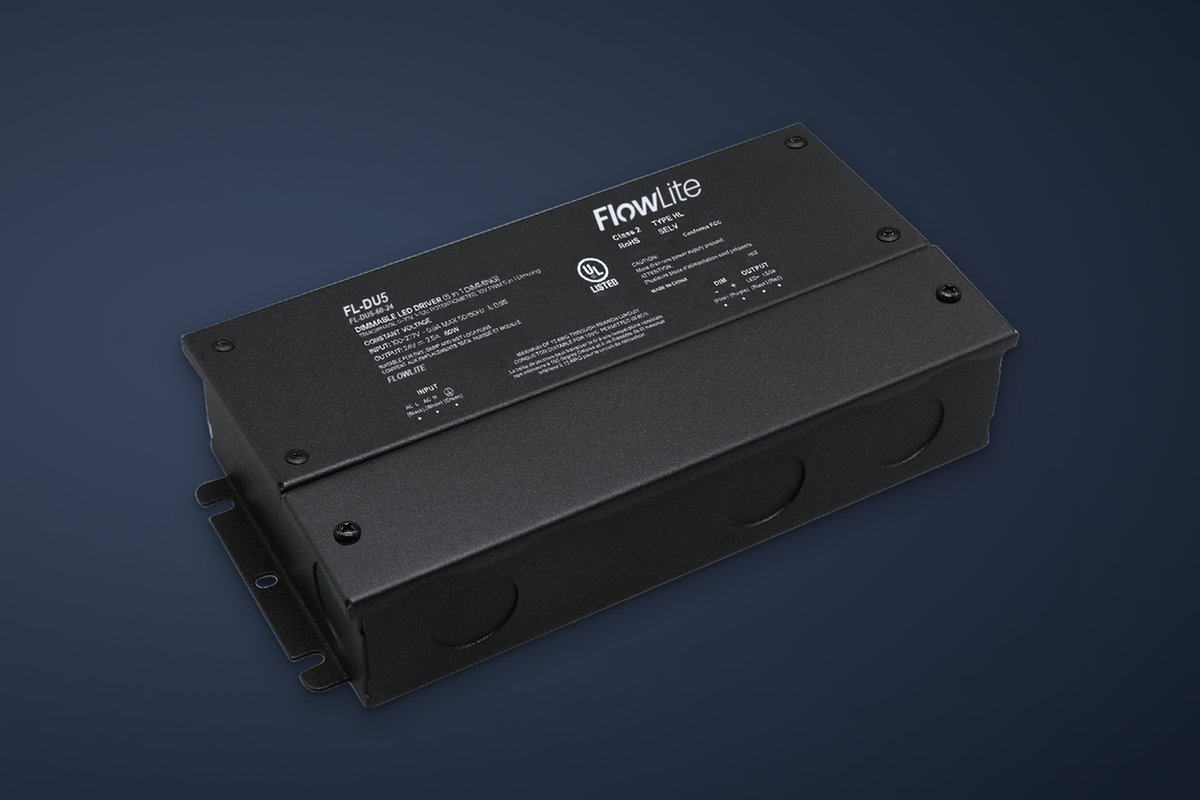
The tape itself doesn't decide how it dims; the driver does. FlowLite tape is fully dimmable, and the choice of driver and control protocol determines how smoothly it dims, how low it goes, and how it ties into the rest of the building's lighting controls.
Phase dimming: ELV and TRIAC
Phase dimmers sit on the line-voltage side and chop part of each AC waveform. The driver reads that chopped waveform and dims its output to match. It's the simplest retrofit path because it uses the existing two-wire switch leg.
- ELV (reverse phase, trailing edge): cuts the end of each half-cycle. Designed for electronic loads, it's typically quieter and smoother with LED drivers, and the usual first choice for phase-dimmed tape light.
- TRIAC (forward phase, leading edge): cuts the start of each half-cycle. Originally designed for incandescent and magnetic low-voltage loads. Widely installed and compatible with many LED drivers, though low-end performance varies.
0–10V
0–10V dimming separates power and control. The driver gets constant line voltage, and a separate pair of low-voltage control wires carries a DC signal: 10V for full output, falling toward 1V for minimum. The driver sinks a small current on the control pair, and the dimmer or control system varies it.
- Four wires to the driver: line, neutral, and the purple/gray (or purple/pink) control pair.
- Very common in commercial work and simple to integrate with occupancy sensors, daylight sensors and building controls.
- At 0V most drivers go to minimum, not off. Turning off requires a switch or relay on the line side, often built into the dimmer.
- Run control conductors in line with the applicable code. Separation or insulation rules apply when they share space with line-voltage wiring.
DMX512
DMX is a digital protocol from the entertainment world, now common in architectural color and tunable-white systems. A controller sends up to 512 channels of 8-bit data per "universe" over a daisy-chained RS-485 cable. Each DMX decoder or driver is addressed to one or more channels.
- A single-color tape run uses one channel; tunable white uses two; RGBW uses four.
- Wire as a daisy chain, not a star, and terminate the last device with a 120 Ω resistor.
- A single segment supports up to 32 standard device loads; use splitters or repeaters beyond that.
- Best for scenes, color, dynamic effects and showpiece installations.
DALI, briefly
DALI is a two-way digital lighting control protocol common in commercial buildings. Each bus supports up to 64 individually addressable drivers, which can report status back to the system. It is well suited to large projects that want individual control and monitoring without DMX's show-control complexity.
Comparison
| Protocol | Wiring | Strengths | Typical use |
|---|---|---|---|
| ELV | 2-wire line voltage | Smooth with electronic drivers, easy retrofit | Residential, hospitality, multifamily |
| TRIAC | 2-wire line voltage | Widely installed, low cost | Residential retrofit |
| 0–10V | Line + separate control pair | Simple, robust, sensor friendly | Commercial, offices, corridors |
| DMX512 | Line + daisy-chained data | Color, scenes, dynamic effects | Retail, hospitality features, façades |
| DALI | Line + 2-wire digital bus | Addressable, two-way feedback | Large commercial projects |
Getting a smooth low end
- Match the driver to the protocol the controls already use.
- Choose drivers with a stated dimming range and flicker-free operation. High-frequency output avoids visible flicker and camera banding.
- Keep each driver loaded properly. Very lightly loaded drivers can misbehave at the bottom of the range.
- Test the full dimming range on site before handover.
Key takeaways
- The driver sets dimming behavior; FlowLite tape is fully dimmable with a compatible driver.
- ELV is usually the best phase-dimming choice for LED drivers.
- 0–10V separates power from control and is the commercial workhorse.
- DMX and DALI are digital: DMX for color and scenes, DALI for addressable building control.