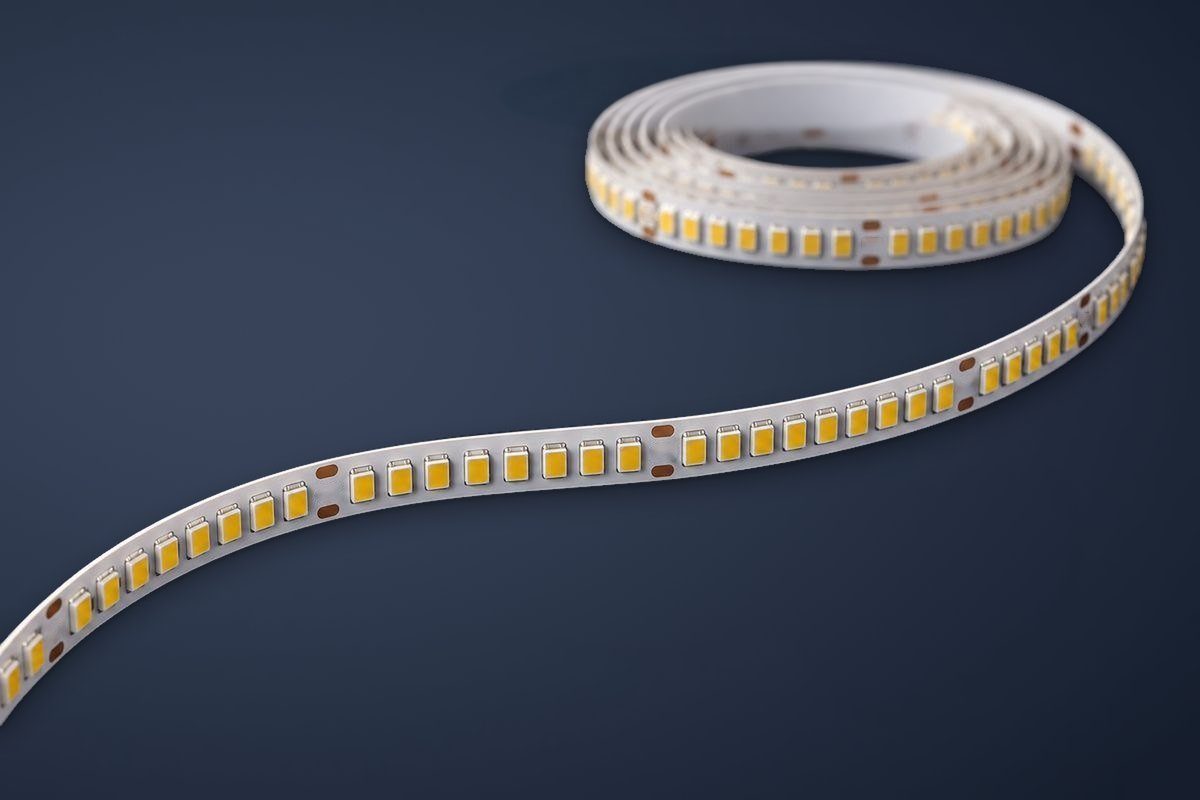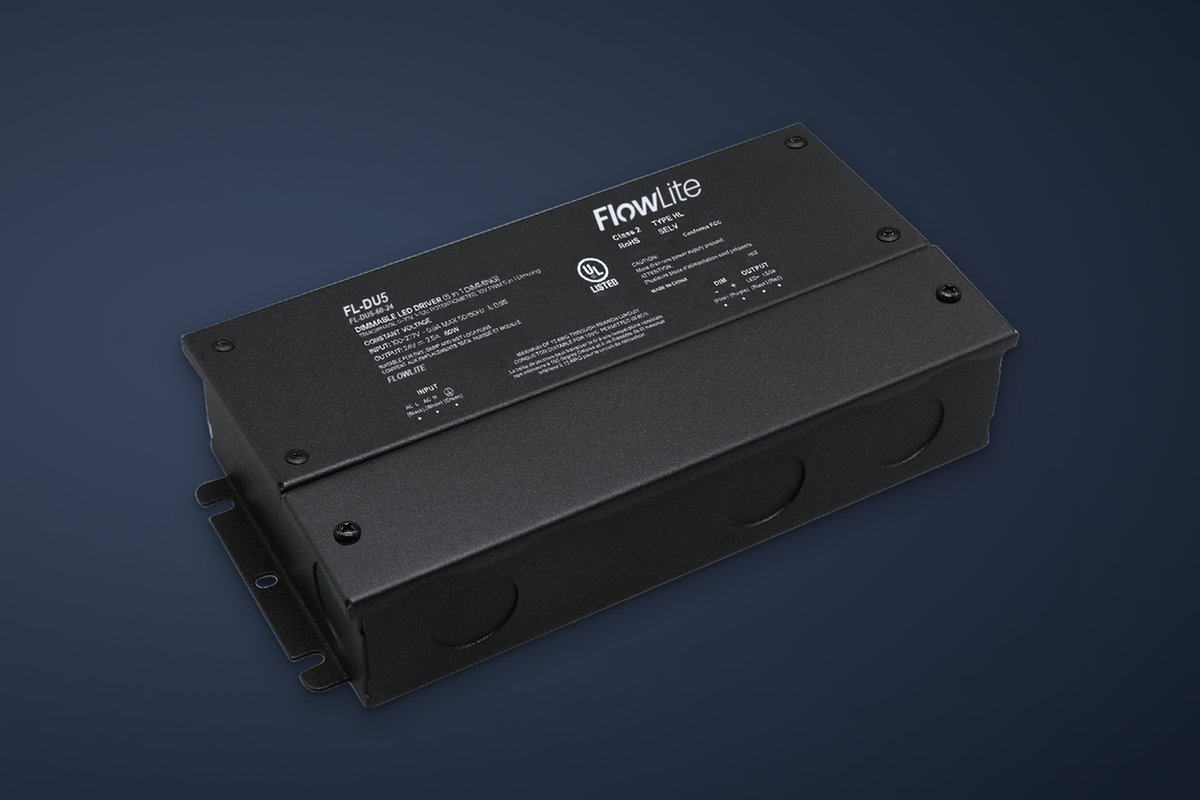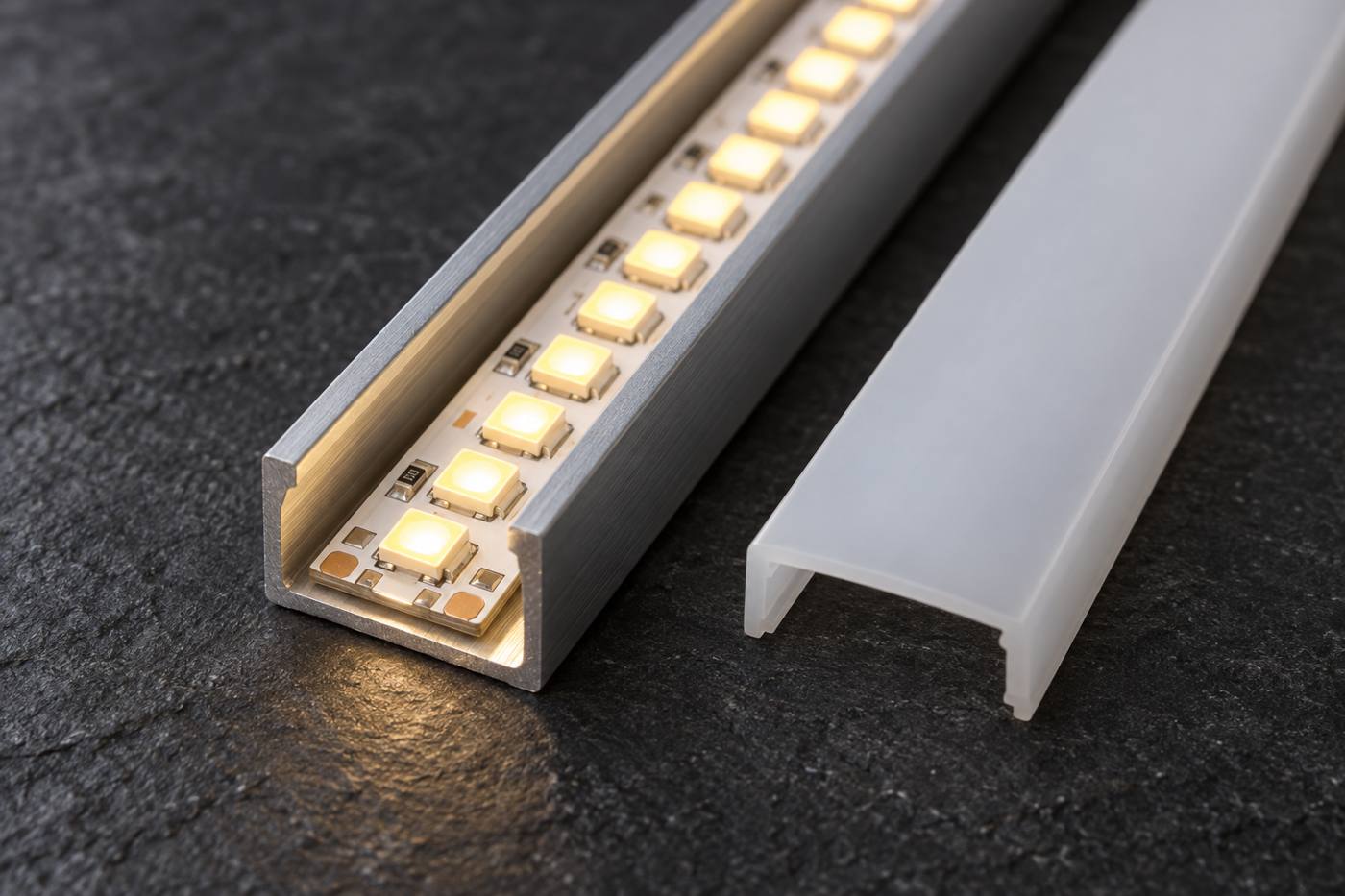
Low-voltage tape light is sold at 5V, 12V, 24V and even 48V. For architectural work, 24V has become the standard, and FlowLite's tape runs on 24V DC. The reason comes down to one piece of physics: for the same power, doubling the voltage halves the current.
The math in one paragraph
Power equals voltage times current (P = V × I). A 16.4 ft run of tape drawing 4.4 W/ft needs about 72 W. At 24V that's roughly 3.0 A; at 12V it's 6.0 A. Voltage drop in a wire equals current times resistance, so the 12V run loses twice as many volts in the same wire. And because 12V has half the starting voltage, that loss is twice as large a share of the supply. Put together, the percentage drop is about four times worse at 12V for the same wire and the same load.
| Same 72 W run | 24V DC | 12V DC |
|---|---|---|
| Current | ≈ 3.0 A | ≈ 6.0 A |
| Voltage lost in the same wire | 1× | 2× |
| Drop as a percentage of supply | 1× | ≈ 4× |
| Resistive loss (heat) in the wire | 1× | ≈ 4× |
| Practical home-run distance at the same gauge | Longer | Roughly one quarter |
What 24V gives you on site
- Longer runs per feed. Lower current along the tape means less drop end to end, which is how 24V tape reaches 16.4 ft per feed even at high output.
- Smaller wire, longer home runs. Drivers can sit farther from the light, in accessible locations, without jumping to heavy-gauge cable.
- Better efficiency. Less energy lost as heat in conductors and in the tape's traces.
- Fewer drivers. More tape per driver output, within Class 2 limits.
Where 12V still shows up
12V tape is common in consumer products, automotive and battery-powered applications, and in some retrofit situations where existing 12V transformers stay in place. 12V tape also usually cuts at shorter intervals, because fewer LEDs are wired in series in each segment. For very short runs in small display cases, that finer cut can be useful.
Modern 24V tape narrows that gap: high-density boards cut every 1–2 inches and free-cut COB can be cut almost anywhere, fine enough for tight millwork while keeping 24V's run-length advantage.
Class 2 and safety
Most tape light systems use Class 2 power, which limits the energy available on the low-voltage side. At 24V, a Class 2 circuit is limited to 100 VA. That is why drivers are commonly rated at 96 W or 100 W per output, and why large layouts use several outputs or several drivers. 12V systems are typically Class 2 as well. Always follow the driver's listing and the electrical code that applies to the project.
Key takeaways
- Same watts at 24V means half the current of 12V.
- For the same wire, percentage voltage drop at 12V is about four times worse.
- 24V gives longer runs, smaller wire and better efficiency.
- Match tape voltage to driver voltage, always.